
School leavers, who lose an entire social world in a single November and often have nothing structured to replace it.
Registered NDIS Provider · 405 358 3296
NDIS Social and Community Participation in Queensland
Getting to the things you actually want to be at.
What is social and community participation support?
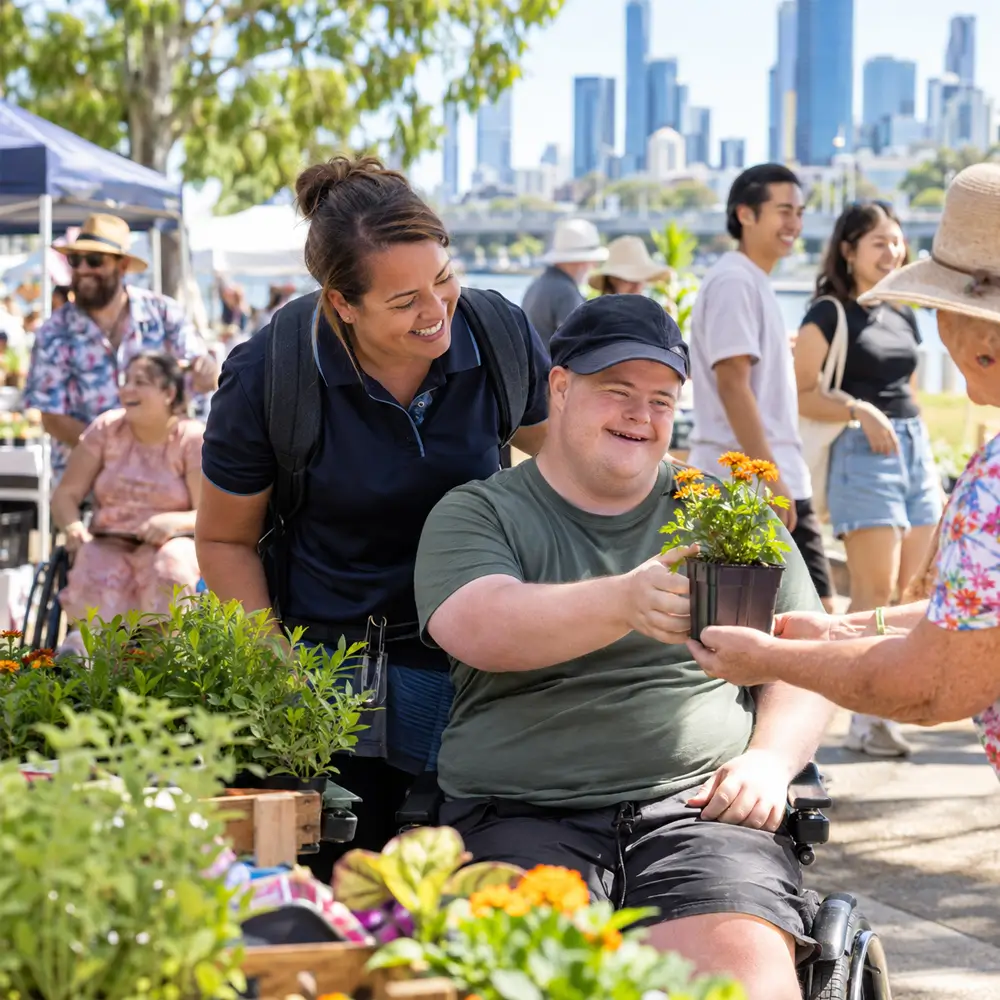
This support funds a worker to help you take part in life outside your home. Classes, clubs, sport, church, the library, the movies, a market, a gym, a men’s shed, a coffee with someone you haven’t seen in a while.
It’s funded from Core Supports, under Assistance with Social and Community Participation, which makes it one of the more flexible parts of a plan. It can be delivered one to one or in a small group, and most people use a mix depending on the activity.
The point of it is not to fill hours. It’s to build a life that has other people in it, ideally to the point where some of those connections keep going without a support worker present.
Who this support helps
People with social anxiety or psychosocial disability, where the barrier is the first ten minutes of walking into a room rather than the activity itself.
Participants who need physical support to attend anything. Someone who needs assistance with transfers or personal care can’t just decide to go to a Tuesday night class.
Younger participants wanting age-appropriate activities rather than programs designed around whoever happens to be in the same funding category.
And families carrying the social load themselves, where a parent has become their adult child’s entire social life and both of them can feel how unsustainable that is.
How the support works
-
We ask what you’re interested in before we suggest anything. That sounds obvious. It is routinely skipped, and it’s why so many participants end up at activities they’d never have chosen.
-
Then we do the research you shouldn’t have to do. What’s actually running near you, what it costs, whether the venue is accessible, whether the group is welcoming or just polite, and what time it really finishes.
-
We go with you at the start. For a lot of people the hard part is walking in the first time, not the activity, and having someone alongside for the first few weeks changes the odds enormously.
-
Then we step back where we can. If you’ve made a connection at a class and someone there would give you a lift, our presence stops being useful. Natural connections outlast funded ones, and building them is the actual goal.
-
Group supports work well for some people and badly for others, so we ask rather than assume. Being placed in a group with people you have nothing in common with, on the basis that you’re all NDIS participants, is not community participation.
The problems participants run into
Activities chosen by the provider rather than the participant. Bowling on Tuesday, the shopping centre on Thursday, the same rotation for years, because it’s what the roster supports.
Group programs that amount to supervised sitting. A room, a television, a worker on their phone, and everybody home by three. It’s billed as community participation and it is nothing of the sort.
Transport dependency, which quietly limits everything. If getting anywhere requires arranging a support shift, spontaneity disappears, and most friendships are built on spontaneity.
Support that never fades, so the participant remains permanently accompanied. Being the person who always arrives with a worker marks you out, and it can prevent the very connections the funding is meant to create.
And the thing that’s hardest to name. A lot of participants aren’t short of activities. They’re lonely. Attending something with a paid worker three times a week can still be lonely, and a provider that measures success in hours delivered will never notice.
How GOTLEHS CARE helps
Interests come first. If you’re into motorbikes, gardening, anime, fishing or the Broncos, that’s where we start looking, not with whatever program has vacancies.
We know our patch. Logan, Brisbane, Ipswich, the Gold Coast, the Sunshine Coast, Toowoomba, Townsville and Cairns all have community groups, libraries, neighbourhood centres and clubs that never appear in a provider’s activity list because they’re not disability specific. Those are usually the better option.
Groups only where they suit. Some participants thrive in them. Others need one to one, and we won’t push someone into a group because it’s more efficient to roster.
And we pay attention to whether it’s working, not just whether it happened. If you’ve been attending something for two months and haven’t spoken to anyone there, that’s worth a conversation rather than another eight weeks of the same.

Tell us what you’re into
Frequently asked questions
If your question isn’t here, ring us on 0425 799 687. We’d rather answer it properly than have you guess.
Which part of my plan funds community participation?
Core Supports, under Assistance with Social and Community Participation. Because it sits in Core, it’s one of the more flexible parts of your plan and funding can usually be moved between Core categories as your needs change.
Do I have to join a group program?
No. Group supports suit some people very well and others not at all. We ask rather than assume, and we won’t place you in a group simply because it’s easier to roster. One to one support is available if that’s what works for you.
Can the support worker help me get there as well?
Yes, transport is usually delivered as part of the same shift. How it’s charged depends on your plan, and we’ll explain what it means for your funding before we start rather than after the first invoice.
What if I want to try something and it doesn’t work out?
Then we try something else. Most people need two or three attempts to find something that fits, and stopping an activity that isn’t working is a sensible decision rather than a failure.
Will I always need a support worker with me?
Not necessarily, and reducing that is often the goal. Where a genuine connection forms at an activity, our involvement can step back. Some participants want company indefinitely and that’s fine too, but it should be your choice rather than the default.