
People travelling in from the smaller Darling Downs towns for appointments and supports, for whom a Toowoomba trip is a scheduled event rather than a quick errand.
Registered NDIS Provider · 405 358 3296
NDIS Provider in Toowoomba, Queensland
The service hub for the Darling Downs, and the furthest west we go.
A registered provider on the Darling Downs
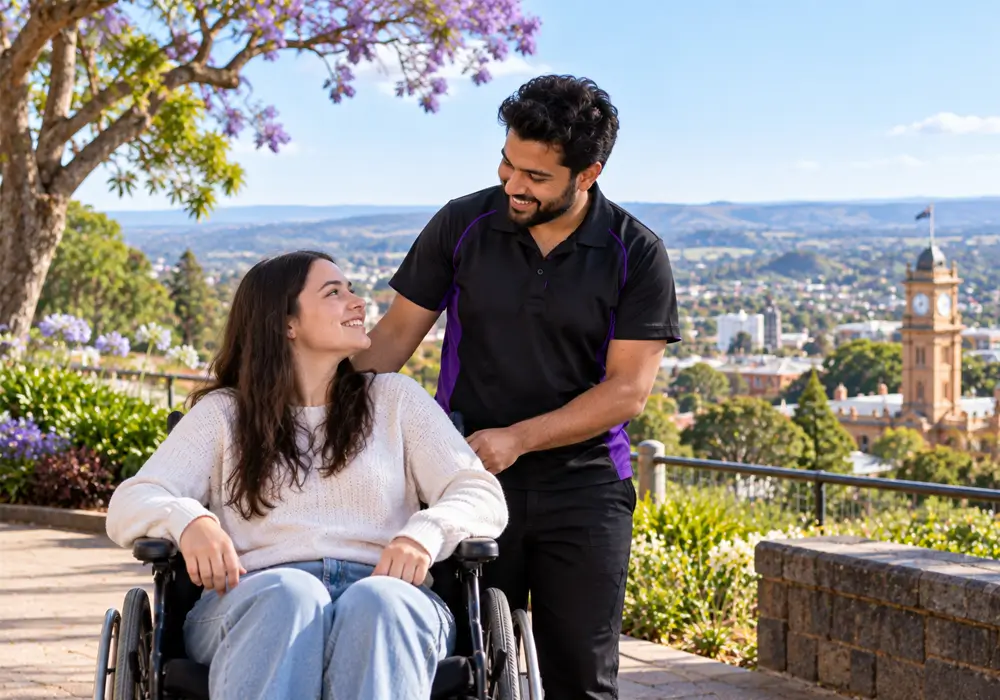
GOTLEHS CARE is a registered NDIS provider, number 405 358 3296. Our office is at Park Ridge, and Toowoomba is the furthest west we service. We’d rather say that plainly than list the whole of western Queensland and disappoint people.
We cover Toowoomba city and the surrounding suburbs including Highfields, Wilsonton, Kearneys Spring, Middle Ridge, Harristown, Newtown and Rangeville.
Toowoomba functions as the service centre for a very large catchment. Participants travel in from Oakey, Pittsworth, Crows Nest, Dalby, Warwick and further out, for supports that simply don’t exist closer to home.
NDIS services we deliver in Toowoomba
All ten registered supports are available. Three matter disproportionately in a regional centre.
Transport, both within Toowoomba and for trips down the range to Brisbane specialists. Social and community participation, because Toowoomba has genuinely strong community infrastructure that participants often aren’t connected into. And daily living skills, since building independence matters more in a place where alternative supports are harder to arrange at short notice.
Also available: accommodation and tenancy assistance, assist life stages and transition, personal care, physical wellbeing activities, therapeutic supports, specialised driver training, and assistance animals and innovative supports.
Accommodation and Tenancy Assistance
Assist Life Stages, Transition and Support
Assist Personal Activities
Assist Travel and Transport
Development of Daily Living and Life Skills
Physical Wellbeing Activities
Social and Community Participation
Therapeutic Supports
Specialised Driver Training
Assistance Animals and Other Innovative Supports
Who we support in Toowoomba
Participants living in Toowoomba itself, across the full range of ages and disability types.
Participants needing specialist care in Brisbane, which means a drive down the range each way and most of a day gone.
School leavers, where post-school options in a regional centre are fewer and fill faster than they do in the metropolitan areas.
And older participants and those with progressive conditions, where the region’s colder winters have a real effect on mobility, pain and how much someone gets out of the house between June and August.
How support works in Toowoomba
-
We plan Toowoomba shifts in blocks rather than scattering them, so participants aren’t all competing for the same narrow window and travel isn’t duplicated.
-
Trips to Brisbane are planned as full days, because that is what they are. We group appointments where possible, and most specialist rooms will move a booking if asked a few weeks ahead.
-
For community participation we work with what Toowoomba actually has, which is more than people expect. Neighbourhood centres, libraries, sporting clubs, the Carnival of Flowers, church and community groups. In a regional city these connections tend to stick better than in a metropolitan one, because the same people keep turning up.
-
And we build for the winter. A support plan designed in February that assumes someone will happily walk to an activity in July needs revisiting, and it’s better revisited in advance.
The problems Toowoomba participants face
Choice is limited. Where a Brisbane participant might have twenty providers to consider, a Toowoomba participant may have three with capacity, and if one isn’t a good fit the options run out quickly.
Allied health is thin, particularly specialist disciplines. Waiting lists are long and some services require travelling to Brisbane, which means a full day and often travel costs on top.
Distance shapes everything for participants coming in from outside the city. Someone travelling from Dalby or Warwick is not popping in for a fortnightly session, and support has to be structured accordingly.
Public transport within Toowoomba is limited compared with the metropolitan areas, which makes transport support more central to a plan working than it would be in Brisbane.
And winter has a genuine effect that gets overlooked by providers planning from the coast. Cold mornings on the range affect pain, mobility and willingness to leave the house, and a plan that ignores it will underperform for a quarter of the year.
What we do about it in Toowoomba
We’re honest that Toowoomba is the edge of our footprint, and we tell you exactly what we can cover before you commit rather than after.
We block-schedule so travel is used efficiently and participants get useful blocks of time rather than fragments.
We plan Brisbane trips as full days and group them, so a specialist appointment can be paired with another appointment, shopping or something the participant actually wants to do while they’re down there.
We build seasonal variation into plans from the start, with a version of the week that works in July as well as one that works in October.
And we work with Toowoomba’s existing community rather than importing a program. In a regional city the local connections are the durable ones, and helping someone into them is worth more than a rostered activity.
Talk to us about supports in Toowoomba
Tell us where you are and what you need, and we’ll tell you honestly what we can cover. Ring 0425 799 687 between 9am and 5pm Monday to Friday, or email info@gotlehscare.com.au.
Frequently asked questions
If your question isn’t here, ring us on 0425 799 687. We’d rather answer it properly than have you guess.
Do you service towns outside Toowoomba?
Toowoomba city and its immediate suburbs are our footprint. We’re not currently able to service Dalby, Warwick, Oakey or the smaller Darling Downs towns. If you’re travelling into Toowoomba for supports we can often work with that, so it’s worth a call.
Can you help with trips to Brisbane specialists?
Yes, and we plan them as full days because that’s what a trip down the range involves. We group appointments where possible, which saves both funding and a great deal of driving.
Are there fewer NDIS options in Toowoomba?
Yes, and it’s worth being honest about it. Choice is narrower than in the metropolitan areas and allied health in particular is thin. That’s part of why we plan supports differently here rather than applying a Brisbane template.
Why does winter matter to my support plan?
Because cold mornings on the range genuinely affect pain, mobility and how willing someone is to leave the house. A plan built in summer that assumes the same routine in July will underperform, so we build a winter version from the start.
How do you schedule supports in Toowoomba?
In blocks rather than scattered across the week, so travel is used efficiently and participants get useful blocks of time. It’s a more practical structure for a regional centre than the metropolitan model of short frequent visits.